
Hear from Our Customers
When a French drain system is working the way it should, you stop thinking about rain. No more checking the basement after a nor’easter. No more soggy patches in the yard that never seem to dry out. No more wondering whether the water creeping into your foundation is doing damage you can’t see yet.
For Melville homeowners, that peace of mind carries real financial weight. With median home values in this area pushing past $1 million, a wet basement isn’t just an inconvenience it’s a liability. Buyers notice it. Inspectors flag it. And the cost to remediate mold or repair foundation damage after the fact runs anywhere from $15,000 to over $50,000. A properly installed residential French drain installation, built to last 30 to 40 years, is a fraction of that.
There’s also the soil factor that most contractors don’t talk about. Melville sits on Long Island’s glacial outwash plain sandy on top, but with thin clay layers underneath that stop water from draining straight down. That clay redirects water laterally, and it often ends up at your foundation. Understanding that subsurface profile is the difference between a drainage system that actually works and one that just looks like it does.
Gold Coast Landworks is a Long Island-based drainage contractor serving western Suffolk County and the Nassau-Suffolk border area. We’re not a national brand with a local phone number. We work in Melville and the surrounding neighborhoods, we know the soil conditions specific to central Long Island, and we understand what’s happening underground when a Melville homeowner calls us about a wet basement or a yard that won’t drain.
Melville falls under the Town of Huntington’s jurisdiction for permits and inspections. We know that process. We handle the filing, the coordination with the Building Department at 100 Main Street in Huntington, and the utility marking before any digging starts. You don’t have to figure out what forms to submit or who to call.
The homes we work on in the Half Hollow Hills area and the residential neighborhoods off Walt Whitman Road are mature, well-landscaped properties. We treat them that way. Every project ends with topsoil replacement, seeding, and full yard restoration because fixing your drainage problem shouldn’t mean losing the yard you’ve spent years building.
It starts with a free on-site assessment. We don’t quote drainage projects over the phone, because a French drain designed without seeing the property is a guess. We come out, evaluate where the water is coming from, how your yard slopes, what the soil looks like, and where the system can outlet. In Melville, that assessment always accounts for the clay interbeds in the outwash profile because that’s what’s usually driving the lateral water movement toward your foundation.
Once we’ve diagnosed the issue, we put together a clear recommendation with material specifications. You’ll know exactly what pipe we’re using, how deep it’s going, what grade of filter fabric wraps the gravel bed, and where the water exits the system. Long Island’s frost depth runs about 36 inches, so pipe burial depth matters here a system installed too shallow won’t survive a hard winter, and we build to last.
Installation on most residential properties in Melville takes one to three days. We handle the 811 utility marking call before any equipment touches the ground. If a Town of Huntington permit is required for your scope of work, we file it and manage the inspection. When we’re done, the trench is backfilled, the lawn is restored, and the system is ready to work.
Ready to get started?
More than 60% of Melville’s homes were built before 1999, and a significant portion of those were built in the postwar era the 1940s through the 1960s. Original drainage designs from that period weren’t built to handle today’s stormwater loads, and any drainage infrastructure installed at construction is now decades past its functional lifespan. If you’ve never had a French drain system installed or inspected, there’s a real chance your property is managing water through luck and soil absorption alone.
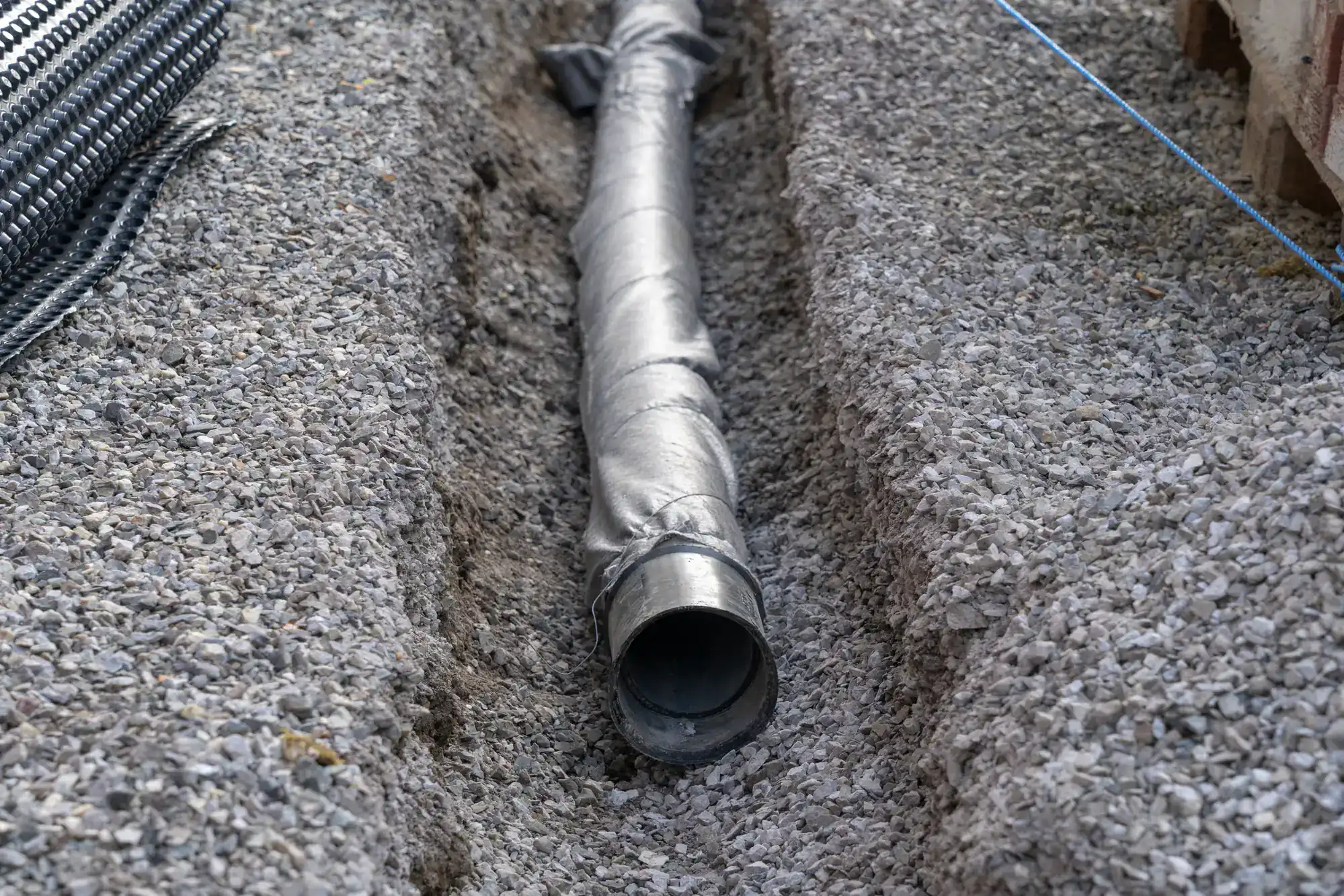
Every French drain installation we do in Melville uses NDS-grade perforated pipe, angular washed gravel, and double-punched geotextile filter fabric wrapping the full gravel bed. Those material choices aren’t arbitrary cheap corrugated tubing, wrong-grade fabric, and round pea gravel are the three most common reasons drainage systems fail within a few years of installation. We specify everything in writing before the job starts, and we stand behind the work with a workmanship warranty.
Depending on what your property needs, the solution might be an exterior perimeter drain around the foundation, a curtain drain intercepting water before it reaches the house, a yard drainage system addressing surface pooling, or a combination of all three. We don’t recommend a system until we’ve seen the property and identified the actual source of the problem because the wrong diagnosis is expensive, and you’ve already dealt with enough water.
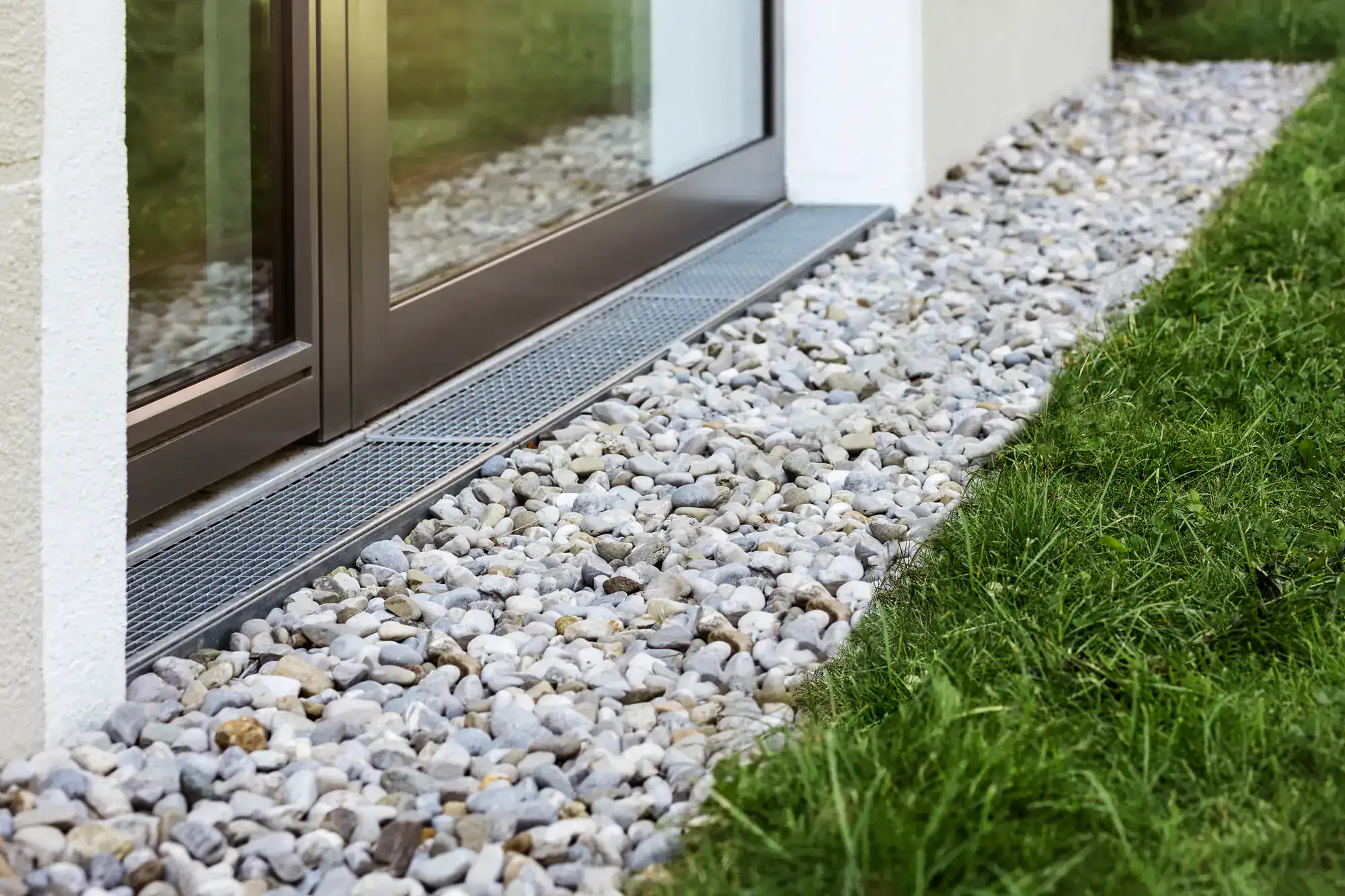
It depends on the scope of the work and where your property sits. Melville is a hamlet within the Town of Huntington, so all permit authority falls under the Town of Huntington Building Department at Town Hall, Room 115, 100 Main Street, Huntington, NY 11743. For most standard residential French drain installations a perimeter drain or a yard drainage system on a typical single-family lot a permit may not be required. But if the work involves altering surface water flow in a way that affects neighboring properties, connecting to existing storm sewer infrastructure, or if your property is near a mapped wetland or flood zone corridor, a permit will likely be required before work begins.
We handle this process for you. We know what triggers a permit requirement in Huntington’s jurisdiction, and we file the paperwork and manage the inspection so you don’t have to navigate it yourself. The 811 utility marking call is also handled before any digging starts that’s non-negotiable on every job, regardless of scope.
This is one of the most common questions we hear from Melville homeowners, and the answer comes down to what’s underneath that sandy layer. Melville sits on Long Island’s glacial outwash plain, which means the upper soil profile is predominantly fine-to-coarse sand but within that sandy matrix, there are thin interbeds of clay deposited during the last ice age. When rainfall saturates the sandy upper layer and hits one of those clay lenses, water can’t continue moving straight down. It moves laterally instead, and it follows the path of least resistance which is often directly toward your foundation wall.
On top of that, the commercial development along Route 110 and Walt Whitman Road has added millions of square feet of impervious surface to Melville’s landscape over the decades. Parking lots, loading areas, and office park hardscaping don’t absorb water they shed it into the surrounding residential neighborhoods. If your basement flooding has gotten worse over the years without any obvious change to your own property, that’s likely a contributing factor. A French drain system designed around your specific site conditions is the right fix not a sump pump alone, and not interior waterproofing that masks the source without addressing it.
Most residential French drain installations in Melville fall somewhere between $5,000 and $12,000, with the average project running around $9,000 to $9,500 depending on scope, depth, and linear footage. Shallow yard drainage systems for surface pooling typically come in at the lower end of that range. Deep foundation perimeter systems which require more excavation and more material run higher. Per linear foot, professional installation generally runs $20 to $60 depending on what the job requires.
What’s worth keeping in mind is what you’re comparing that number against. Foundation crack repair and waterproofing runs $15,000 to $50,000. Mold remediation starts at $3,000 and climbs quickly depending on how far it’s spread. And a wet basement disclosed on a listing in Melville’s real estate market where median home values sit above $1 million can reduce your asking price by 10% or more. A French drain system built with the right materials lasts 30 to 40 years. The math tends to work out pretty clearly in favor of addressing it now.
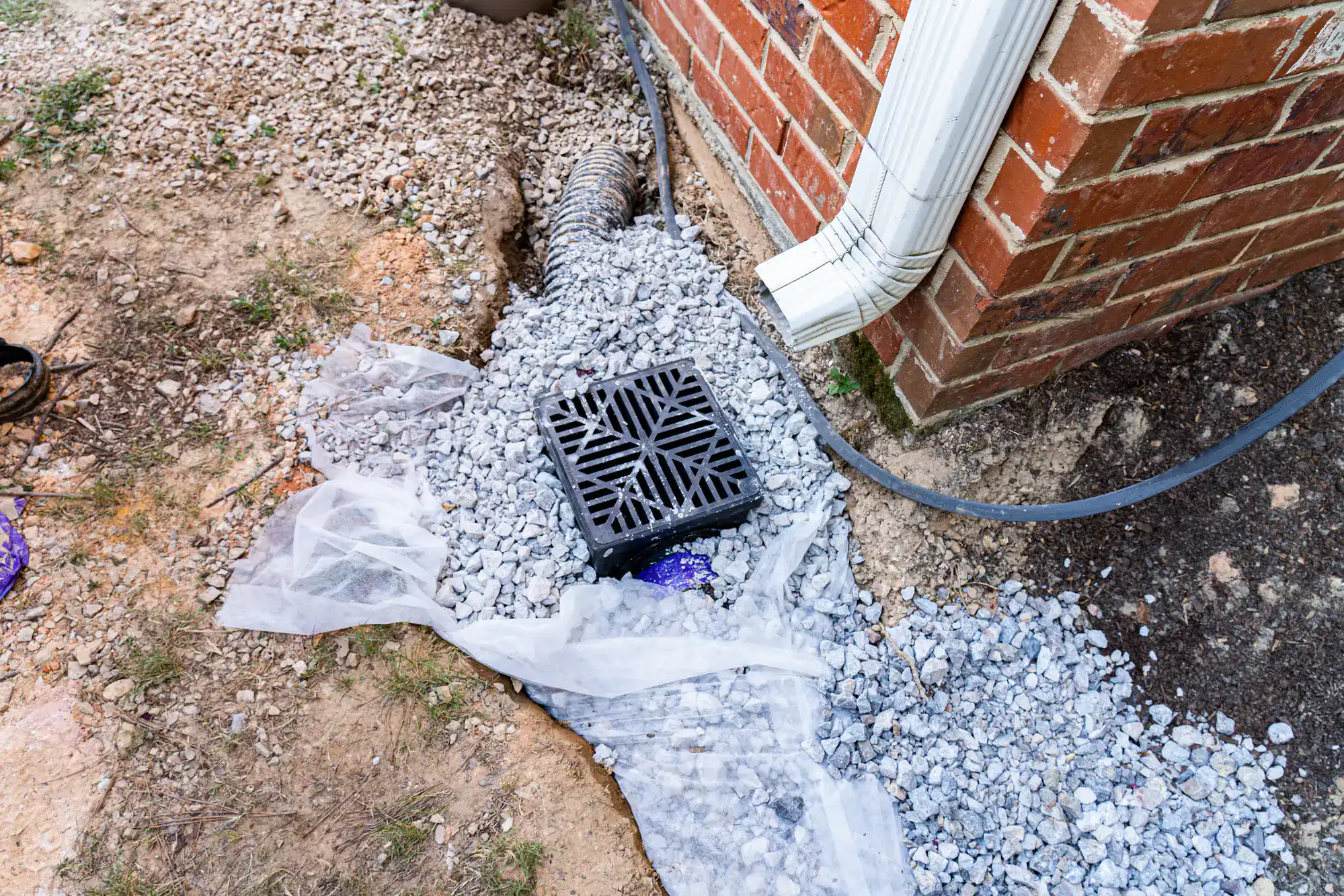
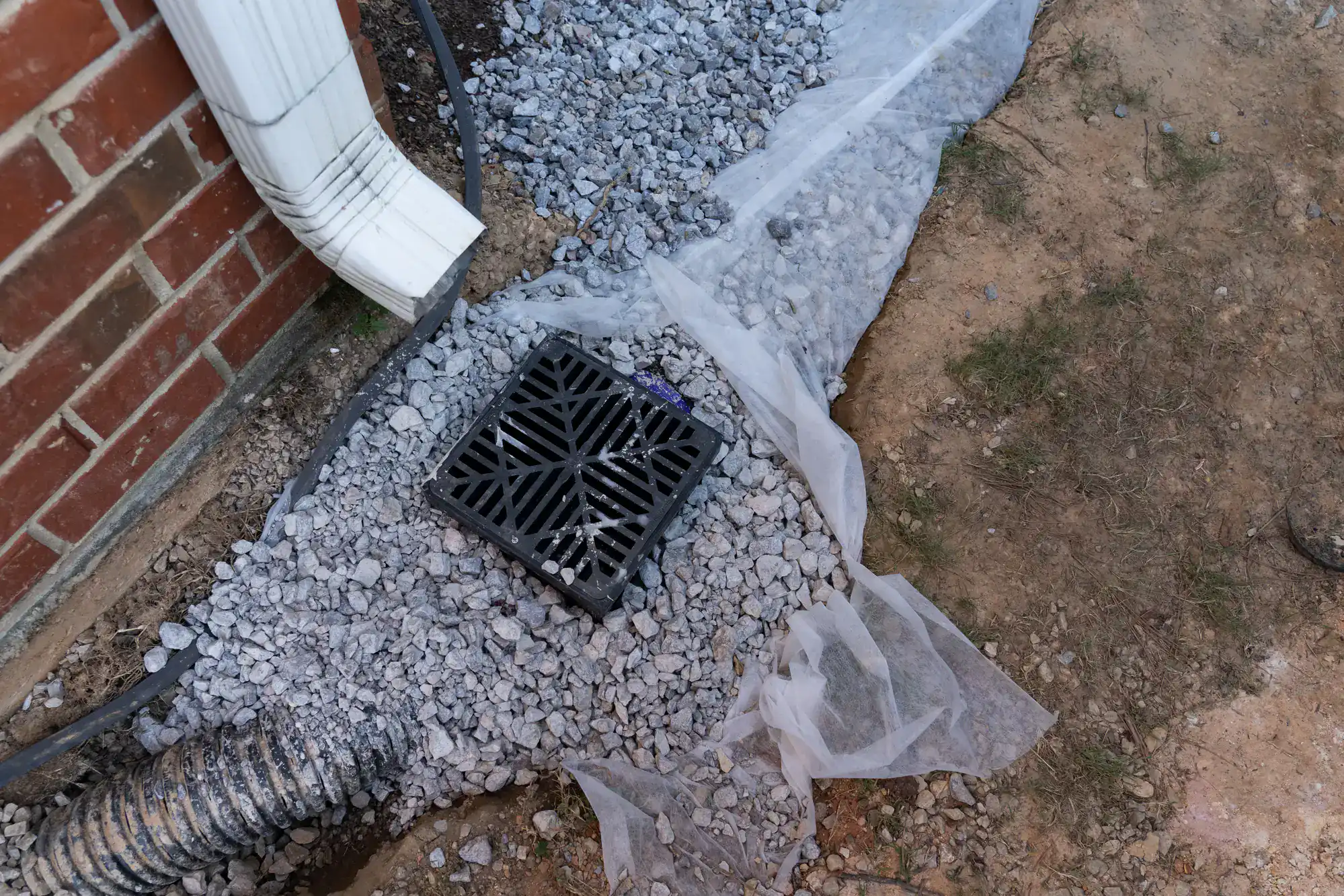
A French drain is a broad term that covers several types of subsurface drainage systems. A foundation perimeter French drain wraps around the base of your home and intercepts water before it reaches the foundation wall. A curtain drain sometimes called an interceptor drain is installed upslope of a problem area to catch groundwater moving toward your house before it gets there. A yard drainage system addresses surface pooling in low-lying areas of the lawn, often connecting to catch basins or outlet pipes.
Which one your Melville property needs depends entirely on where the water is coming from and how it’s moving. If you’re getting basement seepage through the wall, a foundation perimeter drain is usually the right answer. If you have a soggy low spot in the yard that never dries out, that’s often a surface drainage issue that a catch basin and outlet pipe can solve. And because Melville’s subsurface profile includes those clay interbeds that redirect water laterally, some properties need a curtain drain upslope to intercept that lateral flow before it ever reaches the house. The only way to know which system is right is to see the property which is exactly why we start every project with a free on-site assessment.
Depth depends on the purpose of the system, but on Long Island, frost depth is a non-negotiable factor in the calculation. The frost depth for central Long Island including Melville is approximately 36 inches. Any perforated pipe installed too shallow is vulnerable to frost heave during a hard winter, which can crack the pipe, shift the gravel bed, and destroy the system before it ever proves itself. This is one of the most common failure points for both DIY installs and contractors who aren’t accustomed to working in the Northeast.
For a foundation perimeter drain, the pipe typically needs to sit at or near the footing level, which for most postwar Melville homes means 4 to 6 feet down. For a yard drainage or curtain drain system, depth varies based on where the water table sits and where the clay interbeds are located in your specific soil profile. A proper on-site assessment including probing the soil to understand what’s actually happening underground is the only way to specify the right depth for your property. Getting that depth wrong doesn’t just reduce effectiveness; it means the system fails and you’re starting over.
It’s a fair concern, and one we hear often from Melville homeowners who have spent years building a mature yard. The honest answer is that installation requires excavation there’s no way around that. A trench needs to be dug, the pipe and gravel bed need to go in, and the ground needs to be backfilled. For most residential projects in Melville, that work takes one to three days.
What we can tell you is that yard restoration is part of every job we do. That means topsoil replacement, seeding, and cleanup before we leave. The disruption is real but temporary. The drainage benefit is permanent. For homeowners in the Half Hollow Hills area and the established residential neighborhoods around Walt Whitman Road where properties are mature and well-landscaped we work carefully around existing plantings, hardscaping, and irrigation lines. If there are specific areas of your yard you’re concerned about, that’s exactly the kind of thing we talk through during the on-site assessment before any work is scheduled.