Hear from Our Customers
When the job is done right, you’re not standing in your yard wondering what to do with a pile of debris or calling the Town of Brookhaven to sort out a stop-work order. You have a clean, usable piece of property and the paperwork to back it up.
Lake Ronkonkoma sits across three town boundaries Brookhaven, Islip, and Smithtown and most property owners don’t know which municipality governs their lot until something goes wrong. Brookhaven’s Chapter 70 Tree Clearing Permit requirements apply to most of this community, and skipping that step doesn’t just delay your project. It can cost you significantly more to fix than it would have cost to do it correctly from the start.
The soils here are glacially deposited sandy, loose, and fast-draining. That’s great for your lawn, but when you strip vegetation and expose bare ground near the lake’s watershed, erosion becomes a real issue fast. Every land clearing job we take on in Lake Ronkonkoma accounts for that. You get a cleared site that’s stable, compliant, and ready for whatever comes next whether that’s new construction, landscaping, or simply reclaiming space you’ve been meaning to deal with for years.
We are a land clearing and earthworks contractor serving Long Island, with deep roots across central Suffolk County. We’re not a tree service that clears lots on the side, and we’re not an out-of-area operator with a thin location page. This is the work we do, full time, for property owners and developers throughout this region.
We know what bamboo does to a residential block in Lake Ronkonkoma when it’s left unchecked for a few seasons. We know which parcels near the lake’s shoreline trigger Suffolk County DEC review. We know the difference between a Brookhaven permit application and an Islip one and why that matters when your property sits near the boundary. That’s not something you pick up from a directory listing.
When you call us, you’re talking to people who have worked this ground. We show up, we assess the full scope, and we give you a quote that tells you exactly what’s included clearing, stump removal, debris disposal, all of it. No vague lump sums. No surprises at invoice time.
It starts with a site visit. Before any equipment moves, we walk the property with you or on your behalf if you’re not local and assess what’s there: the vegetation type, the density, the proximity to the lake’s watershed, any utility lines, neighboring structures, and anything else that affects how the job gets done safely and correctly.
From there, we determine what permits are required. If your property falls within the Town of Brookhaven and meets the acreage threshold under Chapter 70, we’ll walk you through the Tree Clearing Permit application before a single machine touches your land. If you’re near the lake or a drainage area, we assess whether Suffolk County DEC notification is needed. This isn’t optional it’s the step that protects you from fines and forced replanting down the line.
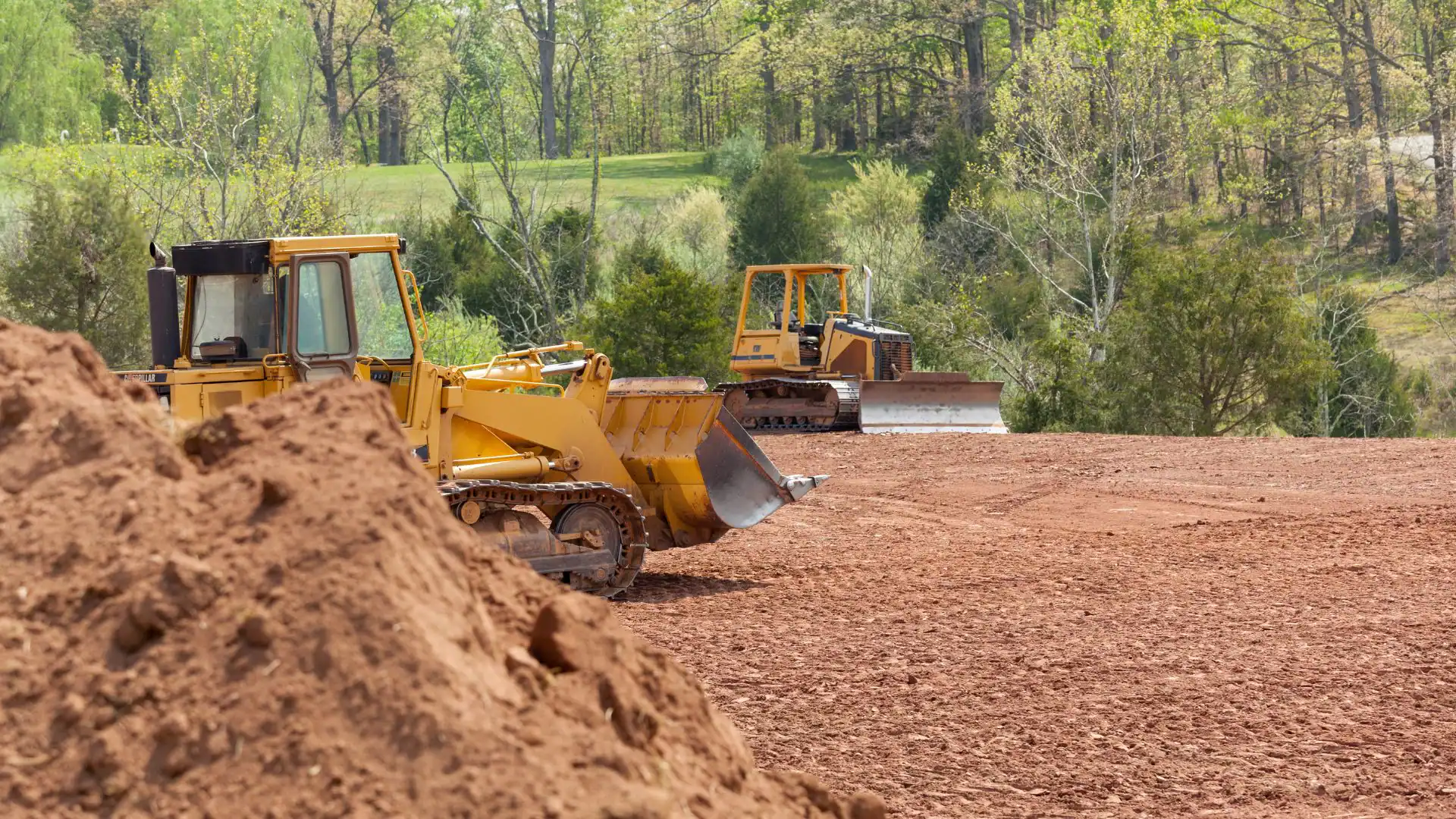
Once approvals are in place, we schedule the work and execute it in a logical sequence: clearing first, stump removal next, then debris removal and site cleanup. If bamboo is part of the picture and on a lot of Lake Ronkonkoma properties, it is we treat the root mass, not just the above-ground growth, because cutting bamboo at the surface and walking away is not a solution. When we leave, the site is clean, stable, and ready for whatever you’re building next.
Ready to get started?
Land clearing in Lake Ronkonkoma isn’t a one-size job. A wooded residential lot near the lake’s shoreline has different requirements than a vacant commercial parcel off Veterans Memorial Highway being prepped for development. We handle the full range land clearing, brush clearing, lot clearing, land reclamation, vegetation removal, and overgrown property clearing and the scope of each job is built around what your specific site actually requires.
For residential homeowners, that often means clearing decades of overgrowth from a property that changed hands through an estate sale, removing an invasive bamboo spread that started in a neighbor’s yard, or opening up a wooded backyard before a pool or addition permit gets filed. For developers and investors active in the Station Yards corridor and the MacArthur Airport expansion zone, it means reliable site preparation with the documentation and compliance record that construction lenders and municipal inspectors expect to see.
Every quote we provide separates the line items clearly clearing, stump removal, and debris disposal are each called out individually. You’re not handed a lump sum and told to trust it. If your project sits near the lake or within a sensitive drainage area, we include an environmental compliance assessment as part of the quoting process at no additional charge. That’s not a selling point it’s just how this kind of work should be done in a community built around the largest freshwater lake on Long Island.
Whether you need a permit depends on your property’s exact location and size. Most of Lake Ronkonkoma falls within the Town of Brookhaven, which enforces a Tree Clearing Permit requirement under Chapter 70 of its Town Code. If your residential property is two acres or more including contiguous lots under the same ownership you need to apply through Brookhaven’s Planning Division before clearing begins. Commercial properties without an approved site plan and subdivisions without a clearing plan approved also require a permit regardless of acreage.
What complicates this for Lake Ronkonkoma specifically is that the community spans three town boundaries Brookhaven, Islip, and Smithtown. Which municipality governs your parcel depends on your exact address, and the permit rules are not identical across all three. Before any work begins, we identify the governing jurisdiction for your specific lot and tell you exactly what approvals are needed. That conversation happens at the quoting stage not after a stop-work order has already been posted.
Land clearing costs in Lake Ronkonkoma vary based on lot size, vegetation density, terrain, and what’s included in the scope. A straightforward residential lot clearing moderate vegetation, no significant stumps, standard debris removal will typically run differently than a heavily overgrown parcel with bamboo infestation, multiple large stumps, and proximity to a regulated drainage area near the lake.
What matters more than the headline number is what the quote actually includes. A lot of contractors in this market price clearing only and leave stump removal and debris disposal as separate surprises at invoice time. When you get a quote from us, clearing, stump removal, and debris disposal are each listed as individual line items. You know what you’re paying for before any equipment arrives. If your property triggers a Suffolk County DEC review or a Brookhaven permit application, we tell you that upfront too because those steps affect your timeline and your budget, and you deserve to know about them before you commit.
It can, depending on how close your property is to the lake, a wetland, or any drainage feature that feeds into the lake’s watershed. Lake Ronkonkoma is the largest freshwater lake on Long Island, and its watershed is actively monitored by the Suffolk County Department of Environmental Conservation. Properties near the shoreline or within areas that drain into the lake’s groundwater recharge zone may require DEC review before clearing proceeds particularly if the work disturbs significant vegetation cover or exposes bare soil near a water feature.
This matters more in Lake Ronkonkoma than in many other Long Island communities because the soils here are glacially deposited sandy and fast-draining which means disturbed ground near the watershed can contribute to erosion and nutrient runoff into the lake relatively quickly. We assess DEC applicability as part of every site visit for properties in this area. If your project requires notification or approval, we walk you through that process. If it doesn’t, we tell you that clearly and explain why.
Land reclamation and lot clearing are related but not the same thing. Standard lot clearing removes trees, brush, and vegetation to prepare a site for construction or improvement. Land reclamation goes further it’s the process of restoring a property that has been overtaken by invasive species, severe overgrowth, or years of neglect to a usable, stable condition. In Lake Ronkonkoma, land reclamation most commonly involves properties where bamboo, phragmites, or decades of unchecked woody growth have essentially consumed the usable area of the lot.
The difference in practice is that reclamation work typically involves more aggressive root system treatment, more extensive debris removal, and sometimes grading or soil stabilization after the vegetation is gone. It’s not just cutting things down it’s restoring the ground to a condition where it can actually be used or built on. If you’ve recently purchased or inherited a property in this area that hasn’t been touched in years, a reclamation assessment is usually the right starting point before any other improvement work begins.
Bamboo is one of the most persistent invasive plants in central Suffolk County, and Lake Ronkonkoma’s dense residential neighborhoods make it a particularly common problem. When bamboo from a neighboring property spreads across a fence line, it doesn’t take long before it’s damaging driveways, pushing through foundations, and overtaking a yard entirely. The reason most bamboo removal attempts fail is that they only address the above-ground growth. Cut bamboo at the surface and the root system called a rhizome network will push new shoots up within a single growing season.
Effective bamboo removal means excavating and removing the rhizome mass, not just clearing the visible canes. Depending on how established the infestation is, this may involve mechanical excavation combined with follow-up treatment to catch any regrowth before it re-establishes. More Long Island municipalities are moving toward ordinances that require bamboo containment or full removal, so addressing it now rather than waiting is both a practical and increasingly a legal consideration. We assess the full extent of the root system before quoting bamboo removal jobs because the scope of that work varies significantly from property to property.
Late winter through early spring roughly February through April is the most effective window for land clearing in Lake Ronkonkoma and across Long Island generally. Deciduous vegetation hasn’t leafed out yet, which makes it easier to assess the full scope of what’s on the property and access areas that become dense and difficult to navigate once spring growth kicks in. Ground conditions are typically firm enough for equipment access without the soft, saturated soil that can complicate work later in the season.
The practical reason to book early, though, is scheduling. The Ronkonkoma area is in the middle of significant development activity the Station Yards project, the MacArthur Airport expansion, and a steady wave of residential construction are keeping contractors busy across central Suffolk County. If you’re planning to clear for a spring or summer construction start, waiting until March to book means competing with every other property owner and developer who had the same idea. Fall is a solid secondary window vegetation thins out again after leaf drop, and it’s a natural time to prepare a site for the following year’s build season. Summer clearing is entirely doable but tends to be more labor-intensive because vegetation is at its densest.