Hear from Our Customers
Copiague sits on glacial outwash geology with a shallow water table that tidal movement from the Great South Bay pushes even higher after storms. That’s not a minor footnote it’s the reason drainage problems are so common in this hamlet, and why excavation work that doesn’t account for it tends to make things worse. When we grade with water management as the actual goal, you stop fighting your yard every time it rains and start seeing water move away from your foundation the way it’s supposed to.
For properties in the southern sections of Copiague especially around Copiague Harbor the tidal influence on groundwater is real and measurable. Work that looks fine in dry conditions can reveal serious problems once the bay pushes water levels up. Getting the grading and drainage outcomes right from the start means you’re not calling someone back six months later to fix what should have been done properly the first time.
Beyond drainage, there’s the issue of lot size. Copiague’s density means you’re often working within feet of a neighbor’s fence, an existing driveway, or a utility line that runs through a corner of the yard. Precision matters here in a way it simply doesn’t on a half-acre lot in a newer suburb. The outcome you’re looking for isn’t just a hole in the ground it’s a site that’s ready for the next phase of your project without collateral damage to everything around it.
We’re a Long Island excavation contractor that works across Suffolk County, including the Town of Babylon communities along the South Shore. That means Copiague isn’t just a pin on our service area map it’s a place we’ve worked in, with the specific soil conditions, permit requirements, and site constraints that come with it.
The Town of Babylon has its own permitting process for excavation work, including sewer excavation permits that require sign-off from the Commissioner of Public Works and final approval through the Bergen Point Sewer Plant. That’s not something you want to learn about after work has started. We know the process, we work within it, and we make sure nothing on the permit side causes your project to stall.
From waterfront grading near Tanner Park to foundation excavation on a postwar Deauville Gardens lot, the work we do in Copiague is specific to this area not a generic Long Island service applied without adjustment.
It starts with a site assessment. Before any equipment is scheduled, we look at what you’re working with lot size, access points, proximity to neighboring structures, and what the ground conditions are likely to be based on where your property sits in Copiague. For anything south of Montauk Highway, that includes an honest conversation about groundwater depth and what it means for your project timeline and scope.
From there, we contact NY 811 to have underground utilities located and marked before a single shovel touches the ground. This is a legal requirement in New York State, and it’s non-negotiable on every job we take. Copiague’s density means utilities are present on virtually every residential block gas, water, sewer, electric, and telecom lines running through yards that don’t have a lot of margin for error. Getting this step done properly isn’t a formality. It’s how we protect your property and the people working on it.
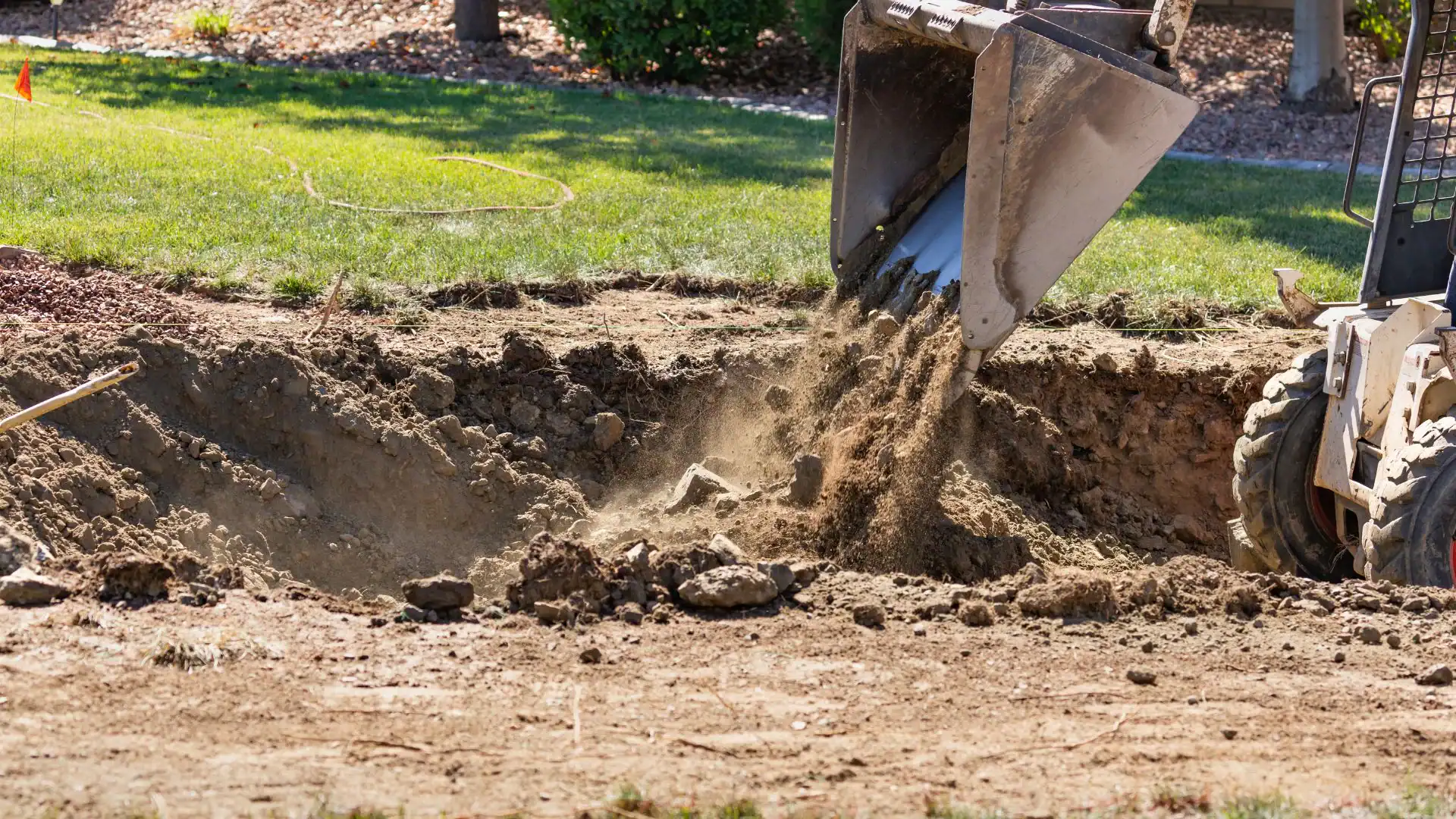
Once the site is cleared and utilities are marked, excavation proceeds according to the agreed scope. Spoil is hauled off your property as part of the job we don’t leave you with a mound of excavated material sitting on a compact Copiague lot with nowhere to go. When the dig is complete, grading is finished to spec, and the site is handed over ready for whatever comes next in your build sequence.
Ready to get started?
Residential excavation in Copiague covers a wide range of project types pool excavations, foundation digs for new builds and additions, drainage corrections, basement waterproofing excavations, and full site preparation for teardown-rebuilds. The hamlet’s housing stock is dominated by postwar construction from the 1950s and 1960s, which means a lot of the work we do here involves properties where the existing drainage and foundation conditions need to be understood before anything is changed. We don’t assume we assess.
For waterfront properties in and around Copiague Harbor, excavation work carries additional considerations. Environmental setback requirements near the Great South Bay, tidal groundwater influence, and the need for grading outcomes that protect rather than compromise the waterfront character of the property all factor into how we plan and execute the job. These aren’t issues you run into on an inland Suffolk County lot, and they require a different level of planning upfront.
Dig and haul is included as part of our full-service scope. Excavated material is removed from your property and disposed of properly which matters on a compact Copiague lot where there’s no room to stage spoil without creating access problems or neighbor complaints. From the first cleared area to the final grade, the entire earthworks scope runs under one contract, with one point of contact, and one crew accountable for the outcome.
It depends on what the excavation involves, but in most cases yes. The Town of Babylon requires permits for excavation work that connects to or runs adjacent to the municipal sewer system. These are called Sewer Excavation Permits, and they require a completed application signed by the contractor, the homeowner, and the Commissioner of Public Works, with final approval coming from the Bergen Point Sewer Plant. The application is submitted through the Town Clerk’s Office and costs $50. It’s a specific process, and skipping it creates compliance problems that are expensive to unwind after the fact.
Beyond sewer-related work, any excavation tied to a building project a new foundation, a home addition, a pool requires a building permit from the Town of Babylon Building Department before work begins. For waterfront properties in Copiague Harbor or along the bay, dredging permits require Town Board approval and carry their own separate fee. The short answer: don’t assume your project is permit-exempt. A quick conversation before you start is a lot cheaper than a stop-work order in the middle of a dig.
It’s one of the most important variables to understand before any excavation project on Long Island’s South Shore. Copiague, along with Amityville and Lindenhurst, sits in an area documented for persistent groundwater issues tied to shallow aquifers and tidal influence from the Great South Bay. In practical terms, this means the water table in parts of Copiague particularly south of Montauk Highway can be close enough to the surface that excavation at depth will encounter groundwater before the planned depth is reached.
For pool excavations, deep foundation work, or any project requiring significant dig depth, this needs to be factored into the scope from the start. Depending on the site, dewatering equipment may be needed to manage groundwater during excavation. Seasonal timing also matters winter and early spring, when ground saturation is highest, are the most challenging periods for deep excavation on South Shore properties. Planning your project for late spring through early autumn generally gives you better working conditions and reduces the risk of timeline disruption from high groundwater.
NY 811 is New York State’s “Call Before You Dig” program the system that locates and marks underground utilities before any excavation begins. It’s not optional. New York State law requires all excavators, whether homeowners or contractors, to contact NY 811 before breaking ground on any project. Once you submit a request, utility companies send locators to mark the positions of underground gas, water, sewer, electric, and telecommunications lines in the work area.
In Copiague, this step is especially important because the hamlet’s density means underground services run through virtually every residential lot. Striking a gas line or severing a water main isn’t just a project delay it’s a safety emergency, and the liability for it can fall on the property owner as much as the contractor. On every project we take in Copiague and across Suffolk County, the NY 811 check is completed before any equipment is deployed. It’s not a box we tick it’s how we make sure the job doesn’t turn into a crisis before it gets started.
Excavation pricing in Copiague varies based on project type, dig depth, site access, and what the ground conditions turn out to be. A straightforward pool excavation on a standard residential lot might run in the range of $1,500 to $4,500 depending on size and spoil removal requirements. Foundation excavation for a new build or addition is typically quoted based on cubic yardage and can range from $3,000 to $10,000 or more for larger footprints. Drainage correction and grading work is usually quoted per project after a site assessment.
What affects cost specifically in Copiague is the combination of lot constraints and South Shore soil conditions. Compact lots with limited equipment access, high groundwater that requires dewatering, and older properties with buried debris or legacy utility lines can all add to the scope. The most important thing you can do is get a written quote that defines exactly what’s included and what circumstances would trigger a change to that number. Vague quotes are where cost surprises come from. Ask for specifics before any work begins.
Waterfront excavation in and around Copiague Harbor involves a different set of considerations than standard residential work. Properties directly on or adjacent to the Great South Bay are subject to environmental setback requirements that govern how close to the water excavation and grading work can be performed. Any project that involves dredging within the Town of Babylon requires approval by resolution of the Town Board it’s not a standard contractor permit, and it takes more lead time to secure.
Beyond the regulatory side, the practical conditions on waterfront lots in Copiague Harbor are more demanding. Tidal groundwater influence means soil saturation levels fluctuate with bay water levels, and excavation work needs to be sequenced accordingly. Grading outcomes on these properties need to direct water away from the structure and toward appropriate drainage paths without compromising the site’s relationship to the bay. The value of properties in Copiague Harbor reflects the premium of waterfront living the excavation work done on them should reflect that same standard of care.
The cheapest quote is almost never the cheapest outcome. In Copiague, where South Shore soil conditions, Town of Babylon permit requirements, and compact residential lots all add complexity to excavation work, the gap between a contractor who knows what they’re doing and one who doesn’t shows up fast usually in the form of drainage problems, permit violations, utility strikes, or a final invoice that looks nothing like the original quote.
When you’re evaluating contractors, ask specific questions: Are they familiar with the Town of Babylon’s sewer excavation permit process? Do they contact NY 811 before every job? Is spoil removal included in the quote or billed separately? What happens if groundwater is encountered at depth? A contractor who can answer those questions clearly and specifically without hedging or deflecting is a contractor who’s actually done this work in this area. A contractor who gives you a low number without addressing those variables is pricing a best-case scenario, not your actual project. The median home value in Copiague is over $500,000. The excavation work that touches that property’s foundation, drainage, and soil structure deserves more than the lowest bid.